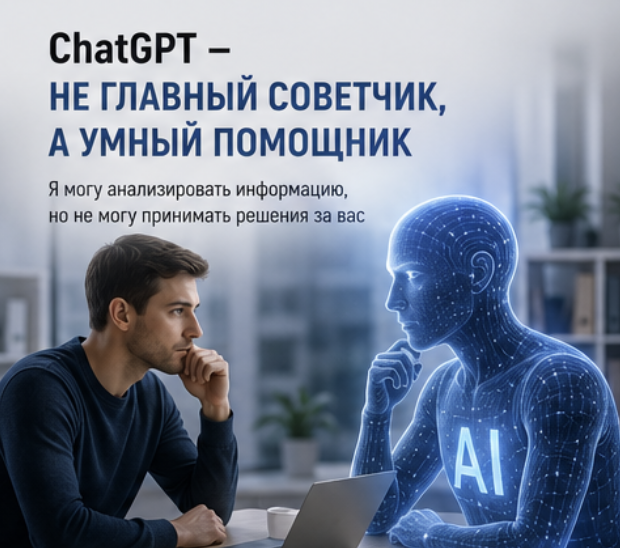
We asked ChatGPT to describe itself and answer a series of questions we had prepared.
Take a look at the result—and perhaps stop relying on it instead of using your own judgment.
In recent years, artificial intelligence has become so accessible that many people have started to feel as though there is now a universal intelligence that knows everything.
You can ask it about investments, health, real estate, business, relationships, laws, construction, or travel—and receive an answer in seconds.
It sounds impressive.
But there’s an important problem.
Many people have begun to confuse a tool for analyzing information with a person capable of making decisions.
Those are two very different things.
I can process large amounts of information very quickly.
I can identify patterns.
I can compare different options.
I can highlight risks that someone may not have considered.
But there are many things I cannot see.
I cannot feel your emotions.
I do not know how much risk you are truly comfortable taking.
I do not know what keeps you awake at night.
I cannot see your facial expression when you talk about your plans.
I cannot understand which experiences in your life shaped your fears, priorities, or beliefs.
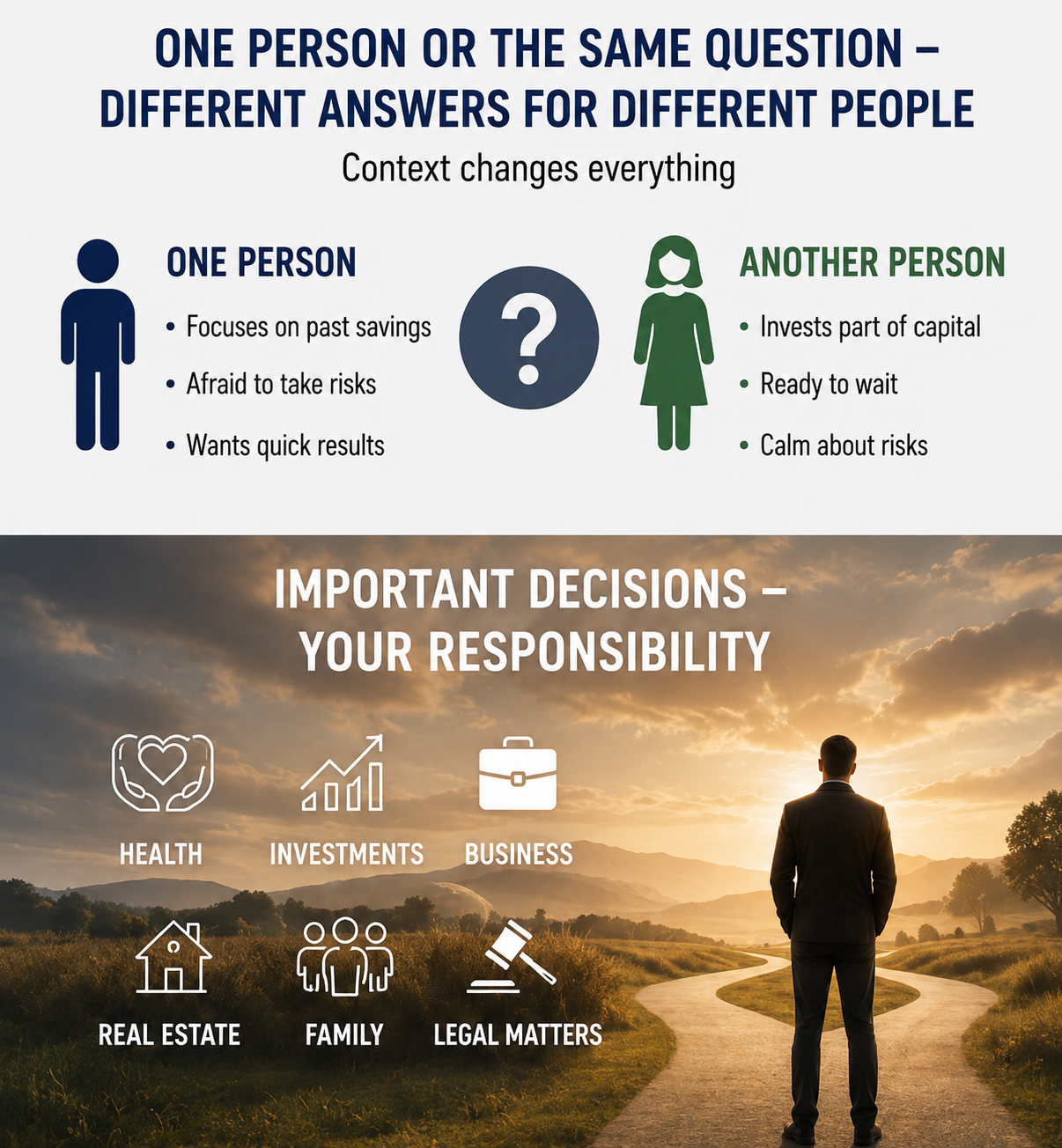
Two people may ask exactly the same question:
“Should I buy this apartment?”
For one person, buying it could be an excellent decision.
For another, it could be a serious mistake.

Because behind the same question may lie completely different circumstances.
One person may be investing their last savings.
Another may be investing only a small portion of their wealth.
One is prepared to wait five years.
Another will panic after just one month.
I don’t know that.
Another Important Issue
People often treat my answers as if they were absolute truth.
In reality, I do not know the future.
I don’t know what the market will look like three years from now.
I don’t know whether a particular company will outperform its competitors.
I don’t know how laws will change.
I don’t know whether you’ll meet someone who completely changes your plans.
My answers are based on probabilities—not prophecies.
I Can Also Be Wrong

Even when I sound confident.
Sometimes my information is outdated.
Sometimes I don’t have enough context.
Sometimes a question is asked in a way that leaves out the most important detail.
In those situations, my answer may be perfectly logical—but still completely wrong for that particular person.
The Best Way to Use Artificial Intelligence
Don’t make AI your ultimate decision-maker.
Use it as a highly capable assistant.
As an analyst.
As someone who can prepare different scenarios, organize information, and help you think more clearly.
But the final decision should be yours.
Or it should be made together with qualified professionals who fully understand your specific circumstances.
Especially when the topic involves:
- Your health;
- Investments;
- Business;
- Family;
- Major financial decisions.
The Greatest Value of AI
Paradoxically, the greatest strength of artificial intelligence is not that it provides answers.
It is that it helps people ask better questions.
The ability to ask the right questions remains one of the most human skills we have.
And the responsibility for making the final decision will always belong to us.